OEM Part Numbers for Keyfobs and other Automotive Remote Controls

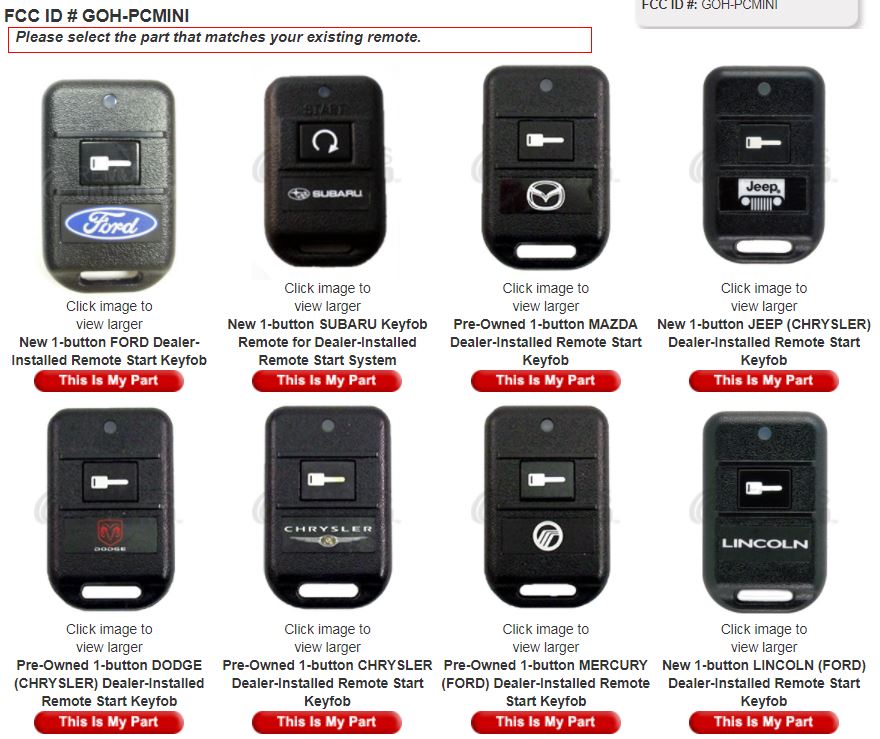
One of the reference numbers that appears on many automotive remote controls – for both factory keyless entry and aftermarket alarm systems – is the part number assigned to it by the original equipment (OE) manufacturer.  If you have an existing part and are uncertain about how to specify the correct replacement part on the Remotes Unlimited website or at an auto parts store, look at your original remote and see if there is manufacturer’s part number on it.  Many remotes have an OE part number on the back of the case.

OE part numbers come in different forms depending on the manufacturer.  Ford uses both letters and digits in their part numbers, such as 2L3Z-15K601-AA.  GM uses 8 digits with no hyphen or spaces.  Toyota, Nissan, Kia and Hyundai all use 10 alphanumeric characters with five on each side of a separating hyphen.  Many aftermarket alarm system part numbers are much shorter, such as 4 digits followed by a letter for many DEI remotes and as few as three digits for Omega.

If your vehicle is equipped with a factory keyless entry system and you want to know the OE part number of your remote to make sure you get the correct replacement part, you can always call your dealership, give them your VIN and ask them to look it up for you.

One cautionary note, however:  auto manufacturers change OE part numbers frequently.  We know of some factory keyless entry remotes that have more than 5 different part numbers for an identical part.  So, just because a replacement part has a different OE part number does not mean it is not the correct part.  Also, some compatible parts may have different OE part numbers because of very slight cosmetic differences – such as the rear function button icon.  Sometimes, one of these compatible parts with a different OE part number may work with your system and be much less expensive.  So always seek help from an expert when you are replacing your automotive remote control.

Bookmark and Share:
Posted in Aftermarket Alarm System Remote, Aftermarket Remote Control, Buying a Car Remote, Car Remote, Keyfob, Keyless Remote | Leave a comment

FCC ID EZSDEI. . .

Automotive remotes and keyfobs with FCC ID EZSDEI . . .  are products of Directed Electronics.  DEI markets aftermarket alarm systems under many brands, including Automate, Avital, Clifford, Python and Viper (to name just a few).  There are also sub-brands such as AviStart, Concept, IntelliGuard, Matrix and many others.

Many of the replacement remote controls for DEI systems are interchangeable.  However, others are not, and it is not always easy to tell by looking at the remote or by the FCC ID shown on the back of the case.  Sometimes, the only difference is the brand or logo on the case.  At other times, the case shape and number of buttons differs.  So, if you are trying to replace your old DEI remote control, be sure you are dealing with a knowledgeable vendor so that you get the right keyfob.

Bookmark and Share:
Posted in Aftermarket Alarm System Remote, Aftermarket Remote Control, Buying a Car Remote, Car Remote, Keyfob, Keyless Remote | Leave a comment

Audiovox – Code Alarm Remote Key Fobs

Remotes Unlimited receives many calls asking about Audiovox and Code Alarm remotes.  Many of the original parts for Audiovox and Code Alarm systems have been discontinued.  Don’t fret though.  There are replacement remotes from Audiovox that work for many of the discontinued remotes.  The newer versions generally look different than the original remotes, but the electronics inside are the same.

As a side note, Audiovox bought Code Alarm several years ago.  Since Code Alarm was such a major player in the aftermarket alarm system market, Audiovox has continued to market systems and replacement parts under the Code Alarm name.  In fact, many automobile manufacturers have put their brands on a Code Alarm system which they sell as a dealer-installed option.

Bookmark and Share:
Posted in Aftermarket Remote Control, Buying a Car Remote, Car Remote, Keyfob | Leave a comment

Micro Alarm Systems Remotes with FCC ID JRMMICRO-30B, JRMT212MHP or N4VMXT251

Micro Alarm is a supplier of aftermarket alarm systems marketed under the same name and also with the brand Barracuda.  Several of their systems used remotes that have one of three FCC IDs shown on the back.  Those are JRMMICRO-30B, JRMT212MHP and N4VMXT251.  These three groups of remotes have some overlapping compatibility, but many of the parts are not interchangeable.  Unfortunately, there are only two ways to specify the correct replacement part reliably.  One is by the alarm system model and the other is by the number printed on the IC chip located on the printed circuit board within the remote.  Button configuration, case shape and FCC ID alone are not sufficient to specify the right part.  So, if you are trying to find a replacement for one of these remotes, be sure the specification process leads to a correct part.

Bookmark and Share:
Posted in Buying a Car Remote, Car Remote, Keyfob | 1 Comment

Internet Regulation and Blackout

Protecting intellectual property and regulating Internet content are huge and hugely important topics. My libertarian-leaning friends (and relatives) are opposed to any Internet legislation regardless of the purpose. They argue, among other points, that any regulation will be incomplete, inequitable and poorly executed by the Federal government. While this editor has some sympathy with these views, I also believe that the issues raised by proponents of legislation have merit. Freedom of individuals in any society can only be real if it includes freedom from harm by others. The Internet fosters certain kinds of abuse, including making it very difficult for a person to protect their very identity, as well as any intellectual property they may create.  As with most issues and disputes, it is important that we the people seek resolution of these views with balance, fairness and harmony as the primary objectives.

Bookmark and Share:
Posted in Uncategorized | 1 Comment

FCC IDs on Aftermarket Alarm and Factory Keyless Entry Remotes

On the Remotes Unlimited website and many competitor sites, you will see reference to the term FCC ID.  You may wonder why this is.  The FCC is the Federal Communications Commission.  This branch of the executive government is responsible for doling out and regulating frequency bandwidth for telecommunications transmissions, including TV and radio.  Most automotive remotes work via radio frequency transmission, so they fall under control of the FCC.

An FCC ID is an identification number assigned to a specific transmission device once it has been approved for use by the FCC.  The first three characters of an FCC ID are a registrant code, identifying the organization that has filed for approval.  The remainder of the ID is a code linked to the specific technology or device that is being registered for approval.

Why does Remotes Unlimited use this information as a search method?  Because often, though not always, the FCC ID on your original remote identifies the specific part.  So, we can use the FCC ID to know what remote you have and which replacement part you need. 

Sometimes, however, an FCC ID does not help with definitive identification because a manufacturer may use the underlying transmission technology in more than one remote.  For instance, we know of at least one FCC ID that was used on more than a dozen different aftermarket alarm remotes, many of which are not interchangeable with each other.  So, just because a keyfob has the same FCC ID as another remote does not mean that the parts are interchangeable . . . but they might be.

Also, FCC IDs are not like patents.  The fact that one registrant receives approval for a certain device working on a certain frequency does not make that device unique.  That is, there is no reason that two remotes with different FCC IDs cannot be interchangeable.  In fact, it is not uncommon for a remote to be replaced by a keyfob with a different FCC ID.  So, in our world of automotive remotes, FCC IDs are important identifiers, but they are not free from ambiguity and confusion.

Bookmark and Share:
Posted in Buying a Car Remote, Car Remote, Keyfob, Keyless Remote | 2 Comments

FCC IDs H5O603 and B23ATxx

A customer inquired about a replacement for his old Autopage remote, which had FCC ID B23AT53 on the back of the case.  Some of these older Autopage remotes are very difficult to find.  Remotes Unlimited happens to know that there is a compatible Car-Pro remote with FCC ID H5O603 on the back that works for this customer’s original part, so we were able to help him out.  However, you have to be careful with these substitutions, because there are several remotes that have FCC ID H5O603 on the back and not all of them are compatible.  Whenever there is a question about which H5O603 remote a customer has, Remotes Unlimited always refers to the part number that sometimes is embossed on the case or, if there is no part number, we refer to the number printed on the IC chip inside the remote.  Complicated, you say?  We agree.  Replacing keyfobs is not always as simple as we would like it to be.

Bookmark and Share:
Posted in Buying a Car Remote, Car Remote, Keyfob | 2 Comments

Remotes Coming Full Circle . . . and, by the way, keys are totally obsolete . . . everywhere

Sometimes, technology advances in a linear fashion and sometimes it winds its way or even cycles forward. 

In the initial era of factory keyless entry remote technology — after automakers developed automatic door locks — you had a key and a keyfob.  The keyfob served the purpose of replacing the key for purposes of locking/unlocking doors and releasing the trunk. 

For some reason, automotive engineers then decided consumers did not really want a keyfob to carry around.  They thought it would be more convenient to have the keyfob built into the key and, voila, the keyhead remote was born.  Unfortunately, the automotive engineers got this “improvement” wrong because the resulting part was so big no one wanted to carry it around.  GM and Ford, you might want to check your consumer research on this one because you seem to be moving headlong in the direction that the more consumer-minded automakers have just abandoned.

So, to correct their error and make the size of the keyhead remote more manageable, the wizards came up with switchblade remotes.  Definitely an improvement, sizewise, and kind of sexy to boot.  Unfortunately, many of the cases did not stand up well to being torqued when the key was turned in the ignition.

Now, finally recognizing that the old mechanical key is and has been the obsolete component all along, the automotive world is gravitating to proximity remotes for security and lock release functions and push-button start for ignition.  No key at all, except for that little “emergency” key blade, which most people will only need when they lose their remote.  Oops, that little key blade is in the remote!  In any event, thirty years after the advent of “factory keyless entry”, the automotive world is becoming truly keyless.

I imagine folks at the automotive key manufacturing companies are wondering what they will be doing in, say, five years.  The answer is that they will be making keys for old vehicles and slowly watching their business disappear.

And, oh, by the way, non-automotive door locks are sure to go the same way.  If keys are obsolete for vehicles, why should door locks not be close behind?  Star Trek had voice-activated, motion-activated and push-button electronic door locks fifty years ago.  I am ready to have one too.

Bookmark and Share:
Posted in Car Remote, Keyfob, Keyless Remote | 1 Comment

Did You Know? – Two-way Remotes

Many aftermarket alarm system manufacturers now make remotes capable of two-way communication.  These are commonly referred to as a “transceiver” because they both transmit and receive signal.  The most advanced transceivers can receive signal from the onboard alarm system module when the vehicle is up to a mile away. 

Two-way remotes can update you with status information about various aspects of your alarm system and vehicle.  We find the most useful status update to be knowing if your engine was started when you are in the house and push the remote start button to warm it up. 

Two-way remotes come in three types — LED, LCD and OLED.  The high-end systems with OLED displays are definitely the sexiest, but OLED displays are more expensive technology, so replacing an OLED remote can be fairly pricey.

Most of these systems also have a “companion” remote keyfob that is only capable of one-way transmission.  We recommend you give the companion keyfob to your spouse and keep the two-way remote for your own use.

Bookmark and Share:
Posted in Car Remote, Keyfob | 1 Comment

Remote Programming: Practice Makes Perfect

A customer recently called us to say that they were having trouble programming their replacement remote.  The problem, as it turned out, was that they could not get their vehicle to go into programming mode.  Our technician helped them over the phone to go through the on-board programming steps carefully.  After several attempts, they were able to get the vehicle to enter programming mode, at which point the new remote was programmed by pressing a single button.

For some vehicles with on-board programming capability, it can be difficult to get the vehicle into programming mode.  This has nothing to do with the remote; it is a function of the control module in the vehicle.  In many cases, we have found that the vehicle will go into programming mode eventually. 

The single most common issue faced is performing the procedure quickly enough.  Most programming sequences have a time limit.  We recommend that a customer read the instructions all of the way through first, before starting the programming procedure.  Also, practice makes perfect.  So do not give up after a single attempt.  Try a few times so that you remember the steps without having to refer constantly to the instruction sheet.  Also, between attempts, be sure to reset the system.  Usually this is done by:  (1) removing the key completely from the ignition;  (2) opening and closing the car door; and  (3) cycling the power door locks.  Good luck and, if you are a Remotes Unlimited customer, we are here to help you over the phone.

Bookmark and Share:
Posted in Uncategorized | 2 Comments